Thursday, 17 January 2019

North America to Retain Dominance in Global Edible Packaging Market

According to a recent business intelligence report by Transparency Market Research (TMR), the demand in the global edible packaging market will increment at a notable CAGR of 6.9% during the forecast period of 2016 to 2024. In terms of revenue, the analyst of the TMR report has estimated the opportunities in the edible packaging market, across the world, to translate into US$1.30 billion by the end of 2024, swelling up substantially from its evaluated worth US$0.77 billion as of 2016.

The TMR report notifies of a fairly opportune competitive landscape in the edible packaging market, with only a handful of players venturing into this relatively niche segment of the packaging industry as a whole. Currently, the shares are significantly consolidated within a small group of players such as JRF Technology LLC, Tate and Lyle Plc., MonoSol, and WikiCell Designs Inc. These players are among the pioneers in the field and are expected to retain their prominence with consistent emphasis on research and development. However, some of the other major players from similar fields with financial might are expected to make a foray into this lucrative market for edible packaging and eat into the global shares. The threat from local and domestic vendors is expected to be moderate to negligible over the course of the aforementioned forecast period.
Based on material type, the edible packaging market has been segmented into surfactants, polysaccharides, composite films, and protein films. End user industries studied under this report for their potential of demand are pharmaceutical and food and beverage producers, who have been further sub-segmented into dairy products, baby food, cakes and confectionery, and fresh food. Geographically, the developed country of the U.S. is anticipated to sustain North America are the region with maximum demand potential, providing for more than 36% of the total demand for edible packaging as of 2016. A number of key players are housed out of this country and localized demands are being served first. However, in a bid to gain greater shares, a number of players are expected to venture into the developing regions in Asia Pacific as well as other developed countries in the European region.


Growing Consumption of Processed Food Driving Demand

Some of the key factors augmenting the demand in the global edible packaging market are: heightening consumption of processed food products among urban populations with disposable income and restless lifestyle, growing awareness regarding the maintenance of hygiene in order to avoid various viral and infectious diseases, and increased among of packaging waste using synthetic polymers that has come under strong scrutiny from a number of governmental agencies. Edible packaging not only has the benefit of producing significantly lower the amounts of packaging waste, they are also made up from films that constitute milk proteins and probiotics that offer nutrients and oxygen shields for the products to refrain from contamination.

Wednesday, 16 January 2019

Flexible Packaging Market to Present Most Lucrative Growth Opportunities


The presence of large number of players in the market and entry of new entrants in the global flexible packaging market is projected to intensify the market competition. The market competition is seen on the basis of price, quality, services, and innovation. The leading players in the market putting efforts by introducing innovative and bio-based packaging materials. Some of the key players in the global flexible packaging market are Berry Plastics Group, Inc., Constantia Flexibles Gmbh, Sonoco Products Co., Mondi Group, Huhtamäki Oyj, and Ampac Holdings, LLC
In a recent report by Transparency Market Research, the global flexible packaging is expected to exhibit 5.2% of CAGR during the forecast period between 2016 and 2024. By rising at a steady CAGR the market is projected to touch US$358.7 bn by the end of 2024 progressing from US$238.5 bn as estimated in 2016.
Based on product type, the stand-up pouch segment has higher demand in the market and is likely to accumulate a valuation of US$85.9 bn by the end of 2024. This is because stand-up pouch has the ability to store different types of products and provides higher shelf life for liquid products. Based on geography, Europe is projected to lead the market and generate a revenue of US$117.7 bn during the forecast tenure. Asia Pacific also shows growth prospects for the flexible packaging market.
Application in Various Industries to Expand Market Growth
Globally, the demand for flexible packaging has increased at a rapid rate, as it can be used for various purposes. Moreover, with advancements in packaging material and packaging technologies the demand in the flexible packaging has also grown at a significant rate. The demand for flexible packaging is also seen in various industries such as food and beverages, consumer goods, pharmaceuticals, and many others. Thus, the growing use of flexible packaging in different industries is projected to boost the demand for flexible packaging and expand the flexible packaging market.
Complex Recycling Procedure to Hamper Market Growth Opportunities
Conversely, some restraining factors that are projected to obstruct the growth of the flexible packaging market. One of the key factor is the use of multiple layer of various types of material are used that makes recycling difficult and is complicated procedure to deal with. In some of the cases plastic and metal are used together for flexible packaging which makes the recycling difficult, as plastic can be recycled is a much easy manner than metal. Moreover, the environmental norms and regulations are getting restrict day by day, which is also hindering the growth of flexible packaging market at the global level.

Green Packaging Market to reach US$203.1 Bn by 2021 End


The global green packaging market features an increasingly competitive vendor landscape. Transparency Market Research (TMR) notes that in the coming years, the constant entry of new players is likely to raise the level of competition in the market. Despite being largely in developmental stage, the market is fast evolving shaped by the changing government regulations in various parts of the globe, which is offering lucrative avenues for companies to capitalize on. To this, numerous agile and astute players are adhering to the existing regional norms. Several players are also focusing on product differentiations and making sizeable investments in research and development activities as key strategies, in order to stay ahead of others, finds TMR. Furthermore, prominent players are focused on brining innovation in the market. 
The top players in the green packaging market are DuPont, Rexam plc., Evergreen Packaging, Mondi plc., Be Green Packaging, Sealed Air, DS Smith, Nampak Ltd., and Amcor Ltd.
The global green packaging market was valued at US$132.4 billion in 2014 and is forecast to reach a worth of US$203.1 billion by 2021. The market is projected to expand at a CAGR of 6.20% during the forecast period of 2015–2021.
The various application areas of green packaging are personal care, healthcare, and food and beverages (F&B) industries. Of these, the F&B packaging is anticipated to lead the global market rising at a CAGR of 6.4% over the assessment period. The rapidly rising demand for green packaging in this end industry is attributed to the widespread consumer awareness of the favorable health impacts of eco-friendly, sustainable packaging.
Geographically, Asia Pacific is projected to rise at potentially attractive pace, driven by extensive and steady demand for green packaging among end consumers, especially in the food and beverages industry. Meanwhile Europe and North America are considered mature regional markets.
Demand to ride on back of Spiraling Awareness of Adverse Ecological Effects of Conventional Packaging
The drive for green packaging or eco-friendly packaging stems from the need for addressing the mounting environmental concern arising out of burgeoning plastic and synthetic material waste generated by conventional packaging across the globe. The green packaging market is witnessing giant strides underpinned by the rising awareness about the environmental impact of conventional packaging materials due to its non-recyclability.
The rising popularity of biodegradable and recyclable packaging among consumers and manufacturers alike is a notable factor boosting the market. The adoption of this type of packaging by end users has helped reduce toxic emissions emitted by the inadequate disposable of conventional packaging materials. In various parts of the world, substantial curbs on the usage of plastic and synthetic materials are also catalyzing the demand for green packaging.

Escalating Consumption of Alcoholic Beverages drives Global Glass Packaging Market


The market dynamics for glass packaging is highly fragmented and the leading six players hold 35% share in the global market. Gerresheimer AG, Owens-Illinois Inc., Vetropack Holding AG, Ardagh Group, Saint-Gobain S.A., and Vidrala SA. are the leading players in the global glass packaging market. These companies use advanced business strategies to maintain their stand in the global glass packaging market. However, various small and medium players working across geographies are also making efforts to strengthen their position in the market.
In order to curb pollution, several companies are focusing on product recycling.  This is likely to help companies gain traction due to increasing environmental consciousness among users. For instance, Ardagh Group has improved recycling efforts in its glass packaging business in North America. This initiative has also increased the furnace performance and reduced energy consumption during glass packaging.
According to TMR, the global glass packaging market is expected to reach US$55.24 bn by the end forecast period in 2020. This market is estimated to expand at a CAGR of 4.6% between 2014 and 2020.
Among the various applications, alcohol beverages (except beer) has emerged dominant. The alcohol beverage segment held more than 40% of the market in 2013. According to the regional analysis, Asia Pacific is leading the global glass packaging market and is projected to rise at a CAGR of 5.3% during the forecast tenure.
Increasing Consumption of Alcoholic Beverages to Boost Market
There are multiple uses of glass packaging in pharmaceuticals, food and beverages, medical supplies, and personal care. The growing consumption of alcoholic drinks especially beer has fuelled the demand in the glass packaging market. The high consumption of beer in developed countries will bode well for the global glass packaging market. In addition to this, the rising consumption of beer in developing nations in Asia Pacific will also contribute towards the market’s growth.
Pharmaceutical companies have also exhibit high demand for glass packaging. Thus, contributed towards the expansion of the global glass packaging market. In addition, the rising use of glass packaging in the cosmetics industry for packaging of nail paints, perfumes, and other beauty products has enabled the market gain momentum.
Availability of Substitutes to Restrict Glass Packaging Market
The presence of substitute is likely to hamper the market performance. For instance the increasing use of plastic packaging may hamper the market’s trajectory. These factors will restrain the market to grow at its full potential. Nonetheless, the increasing awareness pertaining to the negative effects of plastic has sidelined the use of this alternative. Government initiatives to minimize the use of plastic for various reasons will also help in overcoming this restrain.

Increasing Thrust on Plastic Ban Favors Growth of Global Ecological Packaging Market


The fact that plastic has a harmful effect on the environment has been proven time and again. It not only increases toxicity of the ecosystem, but also has harmful impact on life. Rising incidents of health hazards due to plastic pollution has forced policy makers across the globe to implement stringent regulations on the use of plastic.

Many countries have banned plastic paving way for environment-friendly packaging materials. This has favored the global ecological packaging market, boosting its growth in the last few years. A Transparency Market Research report states that the global ecological packaging market will grow at 6.2% CAGR from 2015 to 2021.

What are the leading applications of ecological packaging material driving its demand?

The ban on plastic has forced restaurants and food product manufacturers to switch to alternative serving and packaging materials. This combined with the growing population and increased per capita income has been propelling the global ecological packaging market. The growth of the online food portals has shot up the volumes of home delivery orders. This has fuelled the demand for ecological packaging materials.

Besides food, consumer goods and electronics manufacturers and suppliers also seek ecological packaging materials. The emerging online retail space has witnessed sale of consumer goods and electronics sky-rocket in the past few years. Another industry where ecological packaging materials find application is the packers and movers industry. People are migrating to new cities in search of livelihood and better jobs. This has maintained the momentum of the packers and movers industry, fostering growth in the global ecological packaging market.

What are the benefits of ecological packaging material?

Ecological packaging materials are made out of recyclable materials and are perfectly suitable for the environment. They take lesser time to degrade and do not have any harmful effects on the ecosystem. Paper-based materials are easy to print, thus allowing brands to innovate with their packaging. It also helps companies increase their brand value among consumers. Chemicals in the packaging material do not react with food, thus making it safe for packing. Further, their flexibility makes them suitable for packing electronics and other consumer goods, driving the global ecological packaging market.


While most countries in North America and Europe have banned plastic use, developing nations in the Asia Pacific region are also adopting stringent regulations. India has been pushing for banning plastic across the country, and many cities have already implemented the norm. Recently, the Airports Authority of India (AAI) has banned the use of plastic on all airports across India, a noticeable trend in the global ecological packaging market.

How is the Global Ecological Packaging Market Distributed Geographically?

The growing population in developing nations like China, India, Malaysia, among others will make the Asia Pacific region the leader in the global ecological packaging market. Having implemented the use of ecological packaging materials long ago, North America and Europe will continue to remain significant for the global ecological packaging market.

Existing players in the market are sensing opportunities in new regions and are fast expanding. The introduction of cutting-edge printing technology has given room for creativity and has increased competition in the global ecological packaging market.

Sustainable Juice Packaging characterized by Low Environmental Footprint gathering Steam


Juice packaging exhibits one of the most exciting demand dynamics in the beverages industry. As with other packaging verticals, the demand dynamic is increasingly driven by variety of cost, convenience, and functional considerations among end users. Functional aspects majorly pivot on the packaging that can effectively protect the shelf-life and purity of vegetable and fruit juice products throughout their storage and transportation. There is, thus, a constant demand for better packaging materials that can offer increased barrier resistance to packaged juice products. Apart from this, convenience of packaging for manufacturers as well as for its consumption has emerged out as increasingly important determinant of worldwide consumer demand.

A wide variety of packaging for juice packaging applications has surfaced in various developing and developed regions in response to emerging requirements based on these considerations. In particular, recyclable packaging applications have risen in popularity in the juice packaging market. Rising environmental footprints of juice packaging is a key factor shaping the contours of the market. According to a study by Transparency Market Research, the global juice packaging market is expected to grow from strength-to-strength, driven by several of such aforementioned demand dynamics.

Wide Assortment of Factors shape Demand Patterns of Juice Packaging Applications

The rising demand for packaged vegetable and fruit juice among health-conscious populations is a key factor driving the market. Demand for various types of flexible packaging that score well on convenience aspect for consumers is witnessing an upward trajectory. This has bolstered the demand for bag-in-box covers. Rising health and hygiene concerns among consumers will further bring advancements in flexible packaging. The rising demand for barrier resins in juice packaging is a recent case in point.

Packaging with small footprints is also gaining traction among juice producers and retailers. Growing efforts by manufacturers to increase cost savings across the supply chains is another key proposition that will drive developments in juice packaging market.


Focus toward lessening the environmental footprints of packaging used for juice products has driven the shift toward sustainable packaging. This is catalyzing the use of eco-friendly resins for the packaging materials for juice packaging market. As a result, biomaterials and environment friendly products are generating vast interest among packaging manufacturers, especially in developed markets.

Relentless Focus on Design Innovations and New Packaging Options to open New Frontiers

The juice packaging market is witness increasing evolution momentum from recent efforts to bring improvements in design. This has led to the packaging design that can effectively communicate its value to consumers and provides unique brand positioning to juice producers.

In recent years, PET packaging for juice has gathered considerable steam in various parts of the world. PET packaging with an oxygen barrier is increasingly being demanded among producers of juice for effective protection of the shelf-life of packaged juice. Such trend has given rise to acquisition of PET recycling facilities by raw material producers in emerging markets. For instance, recently Indorama Ventures Limited (IVL) announced that it is soon to acquire Custom Polymers PET. The move will enable it to utilize PET packaging with oxygen barriers. This will help it serve the current and emerging needs of various vertical markets, including juice packaging market.

Ecofriendly Trend in APAC a Boon for Sack Kraft Paper Market


A recent business publication by Transparency Market Research (TMR) has notified that the market for sack kraft paper is steadily prospering, projecting the demand to increment at a CAGR of 2.6% during the forecast period of 2016 to 2024. However, the analyst of the report has strongly recommended the stockholders of the market to consider expansion into the emerging economy of India. The country is vastly populated and the awareness regarding soil pollution caused by plastic is expanding. The government in the country has been taking strong initiatives to curtail the usage of plastic bags and hence, the ones made from sack kraft paper are gaining exponential demand. Revenue-wise, the TMR analyst has estimated the global sack kraft paper market to be worth US$10.5 billion by the end of 2025.
Competitive Landscape Highly Fragmented
Presently, the global shares in the sack kraft paper market are distributed among a large pool of players. Additionally, the entry barriers are fairly low owing to the easy availability of the technology as well as the raw materials. A number of regional and domestic players are throwing their hat into the field and are able to eat out substantial shares. That being said, a few players such as Mondi Group, BillerudKorsnas AB, KapStone Paper and Packaging, Smurfit Kappa, and Nordic Paper are ahead of the curve and are expected to retain their position of prominence in the near future too. This can be attributed to their financial might to innovate. These players are investing significantly on research and development activities in order to produce products that protect consumers as well as the products. Development of moisture resistant products is another niche.
These players also have a strong product portfolio that meets diverse demands. For instance, Mondi Group offers Advantage Kraft, both white and brown, Advantage Speed, monopol market pulp, and FIBROMER Fibers. These products are extensible sack kraft paper that combines high tensile strength, runnability, and high porosity. In addition to enhancing product portfolio, major players are also expected to indulge into mergers and acquisitions, which helps them strengthen their product portfolio.
Moisture Resistant Products Creating a Niche
Going forward, the demand for ecofriendly packaging is expected to restructure a number of industries, particularly the food and beverage industry. But that is not the only source of demand. The vendors of the sack kraft paper market are concentrating on catering to the cement, chemical, agrochemical, and industrial and building material industries for newer demands. These industries have to abide by stringent government regulations to maintain environment norms and opting for materials packaged with sack kraft paper helps them. On the other hand, high cost of raw materials such as soft wood is expected to remain a restraint over a greater profitability of this market.
Based on grade, the TMR report segments the sack kraft paper market into brown and white. While the brown grade is cheaper, white sack kcraft paper as a result of bleaching, helps in improving the appearance for the packaged products, as well as are printing friendly. Based on packaging-type, the market has been bifurcated into open mouth sack and valve sack. End users studied under this report are animal food, pet food, chemicals, cement and building materials, and food and beverage.
Geographically, China is maintaining Asia Pacific as the region with maximum potential. The country accounted for nearly 60% of the total demand from the region that was dominating the global demand as of 2017. Together with India, APAC is primed to lure the attention of stockholders across all regions. That being said, European and North American regions are expected to generate substantial chunk of demand in the near future too.

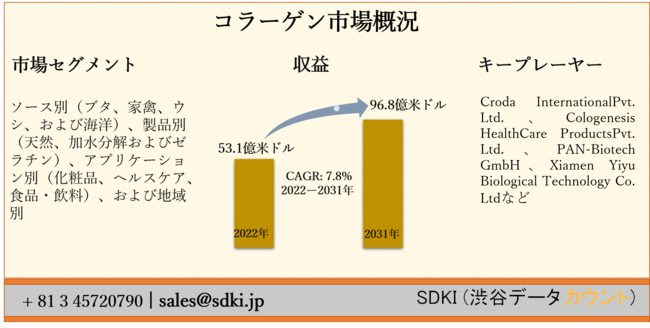
Collagen Market-By Source (Pig, Poultry, Cow, and Marine), By Product (Natural, Hydrolyzed and Gelatin), By Application (Cosmetics, Healthcare, Food and Beverage), and By Region-Forecast 2022-2031

SDKI Inc. published a new report on the collagen market on January 25, 2022.  This study includes the statistical and analytical approaches ...