Thursday, 17 January 2019

Plastic Packaging Market – Proliferation of Food & Beverage Industry Fuels Growth

The global plastic packaging market features a fragmented vendor landscape with the presence of several well-established players. Keen players are pouring money into research and development for product advancement. They are also adopting the inorganic growth route, thus entering into partnerships and alliances with small market players.

Prominent companies operating in the global plastic packaging market include Bemis Company Inc., Mindi plc, Ampac holdings LLC, Ukrplastic Corporation, Amcor Ltd., Constantia Flexibles International GmbH, Huhtamaki Oyi, sealed Air Corporation, Sonoco Products Company, and Wipak Group.

As per a recent market study by Transparency Market Research (TMR), the global plastic packaging market is predicted to clock a CAGR of 5.20% between 2014 and 2020, for the market to be worth US$370.2 bn by 2020 end. The demand in the market translated into a revenue of US$259.6 bn in 2013. By product, the global plastic packaging market has been segmented into rigid and flexible. Of the two, rigid packaging segment presently holds the leading market share. The report estimates the rigid packaging segment to continue to lead through the forecast period. By end use, food and beverages held the leading more than 65% of the overall market in 2013; the segment is anticipated to remain at the fore through 2020.

Geography-wise, Asia Pacific displayed the leading demand to account for 35% of market share in 2013. The region is likely to remain at the lead due to the rising use of plastic packaging in the food and beverage and healthcare industry.


Proliferation of Food & Beverage Industry Fuels Growth

Proliferation of the food and beverage industry is one of the key factors driving the plastic packaging market. Plastics serve to provide a tougher, cleaner, and aesthetically appealing form of packaging for the food and beverage industry. There lies strong demand for lot of products to be manufactured in pouches, plastic bags, and sachets. Plastic packaging provides advantages of strength and durability that is far superior to any other material for the same price.

The growth of the healthcare industry has boosted the plastic packaging market to a high degree. Medicinal solutions, syringes, IV bags, IV tubes are some of the things extensively used in the healthcare sector use plastic packaging. Plastic packaging helps maintain hygiene and are less susceptible to damage, leaks than glass packaging.

Leading Players to Introduce Bio-Based Packaging Material that may Boost Demand in Global Flexible Packaging Market

The presence of large number of players in the market and entry of new entrants in the global flexible packaging market is projected to intensify the market competition. The market competition is seen on the basis of price, quality, services, and innovation. The leading players in the market putting efforts by introducing innovative and bio-based packaging materials. Some of the key players in the global flexible packaging market are Berry Plastics Group, Inc., Constantia Flexibles Gmbh, Sonoco Products Co., Mondi Group, Huhtamäki Oyj, and Ampac Holdings, LLC

In a recent report by Transparency Market Research, the global flexible packaging is expected to exhibit 5.2% of CAGR during the forecast period between 2016 and 2024. By rising at a steady CAGR the market is projected to touch US$358.7 bn by the end of 2024 progressing from US$238.5 bn as estimated in 2016.

Based on product type, the stand-up pouch segment has higher demand in the market and is likely to accumulate a valuation of US$85.9 bn by the end of 2024. This is because stand-up pouch has the ability to store different types of products and provides higher shelf life for liquid products. Based on geography, Europe is projected to lead the market and generate a revenue of US$117.7 bn during the forecast tenure. Asia Pacific also shows growth prospects for the flexible packaging market.


Application in Various Industries to Expand Market Growth 

Globally, the demand for flexible packaging has increased at a rapid rate, as it can be used for various purposes. Moreover, with advancements in packaging material and packaging technologies the demand in the flexible packaging has also grown at a significant rate. The demand for flexible packaging is also seen in various industries such as food and beverages, consumer goods, pharmaceuticals, and many others. Thus, the growing use of flexible packaging in different industries is projected to boost the demand for flexible packaging and expand the flexible packaging market.

Complex Recycling Procedure to Hamper Market Growth Opportunities

Conversely, some restraining factors that are projected to obstruct the growth of the flexible packaging market. One of the key factor is the use of multiple layer of various types of material are used that makes recycling difficult and is complicated procedure to deal with. In some of the cases plastic and metal are used together for flexible packaging which makes the recycling difficult, as plastic can be recycled is a much easy manner than metal. Moreover, the environmental norms and regulations are getting restrict day by day, which is also hindering the growth of flexible packaging market at the global level.

TMR Predicts Limited Growth for Stretch and Shrink Films in Food and Beverages Sector

Berry Plastics, Dow Chemicals, Fuji Seal International Inc. are the light bearers in the worldwide stretch and shrink films market . These players, and also other conspicuous members, are progressively concentrating on coordinated efforts with neighborhood wholesalers and growing operations in developing nations to combine their position in the market, watches Transparency Market investigate (TMR) in another examination.

A few players are accentuating on growing their geological effort to improve their perceivability in the market. For instance, Bemis Company Inc. commits impressive assets in reinforcing its position in China, India, and South America. In December 2015, the organization gained Emplal Participações S.A., a producer of plastic bundling in Brazil.

The open door in the worldwide stretch and shrink films market had a valuation of US$14.1 bn in 2015 and is ready to display a CAGR of 5.2% in the vicinity of 2016 and 2024, achieving US$21.1 bn by 2024. Based on product, the market is anticipated to be led by the segment of shrink films owing to the growing use of light-weight packaging films. The low density polyethylene (LDPE) material segment is the chief contributor to the evolution of stretch and shrink films market. Nevertheless, it is anticipated to lose noteworthy market share to other materials such as linear low density polyethylene (LLDPE), PVC, and polypropylene.

Region-wise, the global market for stretch and shrink films has been classified into the Middle East and Africa, Latin America, Asia Pacific, Europe, and North America. Asia Pacific is relied upon to lead the market all through the estimate time frame and furthermore enlist the quickest development. The market for stretch and shrink films in North America and Europe are somewhat develop and are relied upon to lose a critical offer of the worldwide market to Asia Pacific.


Asia Pacific offers new open doors for players occupied with assembling stretch and psychologist films as the locale has been seeing an expansion in interests in the assembling area, quick pace of urbanization, and growing transfer salary. Enter players working in created extend and recoil films markets, for instance, North America and Europe are concentrating on APAC with a specific end goal to duplicate their income by ideally using the shoddy assets accessible in India and a few ASEAN nations.

Growing Consumption of Beverages and Food to Augment Sales of Stretch and Shrink Films 

In the packaging industry, adaptable bundling is quickly making advances into the offers of unbending packaging. The previous is supplanting the last in a few applications, rising as the most encouraging section. Among various sorts of adaptable packaging, stretch and shrink films are exceedingly famous and broadly utilized all through the store network. The expanding notoriety of adaptable bundling is, along these lines, one of the essential development stimulants of the worldwide stretch and shrink films.

Global Cosmetic Packaging Market to reach worth of US$33 Bn by 2024 End

The global cosmetic packaging market is characterized by intense rivalry between the top players, observes Transparency Market Research (TMR). Product development has emerged as the prime strategy for the majority of players to garner competitive advantage over others. They are leveraging the potential of cutting-edge technologies and advanced materials to design high-performance packaging solutions, in order to consolidate their shares. TMR notes that several prominent players are capitalizing on multi-dimensional image processing technology to develop innovative solutions.

Leading players operating in the global cosmetics packaging include HCP Packaging, Albea S.A., Fusion Packaging, ABC Packaging Ltd., Libo Cosmetics Company Ltd., RPC Group Plc, Quadpack Industries, Aptar Group Inc., AptarGroup, Inc., Gerresheimer AG, and Amcor Limited. The market is expected to provide many a promising avenues for manufacturers across the globe to bank upon.

The global cosmetic packaging market is projected to rise at a modest CAGR of 4.4% during the assessment period of 2016–2024, which will propel the market to reach a worth of US$33 billion by the end of 2024. The market was valued at US$23 billion in 2015.

The variety of materials used for cosmetic packaging consists of glass, plastic, paper, metal, and wood. Of all the segments, plastic leads the pack, vis-Ă -vis value and volume. The segment is expected to hold almost half of the overall share in the global market. However, the uptake of other packaging materials are rising rapidly owing to the preference of eco-friendly packaging materials.


Geographically, Asia Pacific led the global market in 2016 and is expected to contribute potentially high revenues through 2024. The prominence of the regional market can be attributed to the presence of a plethora of manufacturers in key economies and a considerable consumer base.

Proliferation Demand for Cosmetics among Millennials bolsters Uptake  
The cosmetic packaging is expected to grow from strength to strength underpinned by the several attractive strides being made by the cosmetics and personal care industries. The key role occupied by packaging in the brand positioning in the overall cosmetics market has provided sustained thrust to the expansion of the market. The rising demand for functional packaging that offers remarkable product protection and higher consumer functionality is a notable factor catalyzing the market growth.

The cosmetics industry is witnessing bold strides driven by the rising uptake of cosmetic products among millennials. The rising demand for effective packaging for a staggering volume of anti-aging creams and other skincare products is propelling the growth of the cosmetic packaging market. The substantial demand for an array of cosmetics among young adults in various developing regions has accentuated the demand for the packaging.

Sack Kraft Paper Market – Strengthening Construction Industry in Asia Pacific Promises Lucrative Opportunities

A recent business publication by Transparency Market Research (TMR) has notified that the market for sack kraft paper is steadily prospering, projecting the demand to increment at a CAGR of 2.6% during the forecast period of 2016 to 2024. However, the analyst of the report has strongly recommended the stockholders of the market to consider expansion into the emerging economy of India. The country is vastly populated and the awareness regarding soil pollution caused by plastic is expanding. The government in the country has been taking strong initiatives to curtail the usage of plastic bags and hence, the ones made from sack kraft paper are gaining exponential demand. Revenue-wise, the TMR analyst has estimated the global sack kraft paper market to be worth US$10.5 billion by the end of 2025.

Presently, the global shares in the sack kraft paper market are distributed among a large pool of players. Additionally, the entry barriers are fairly low owing to the easy availability of the technology as well as the raw materials. A number of regional and domestic players are throwing their hat into the field and are able to eat out substantial shares. That being said, a few players such as Mondi Group, BillerudKorsnas AB, KapStone Paper and Packaging, Smurfit Kappa, and Nordic Paper are ahead of the curve and are expected to retain their position of prominence in the near future too. This can be attributed to their financial might to innovate. These players are investing significantly on research and development activities in order to produce products that protect consumers as well as the products. Development of moisture resistant products is another niche.

These players also have a strong product portfolio that meets diverse demands. For instance, Mondi Group offers Advantage Kraft, both white and brown, Advantage Speed, monopol market pulp, and FIBROMER Fibers. These products are extensible sack kraft paper that combines high tensile strength, runnability, and high porosity. In addition to enhancing product portfolio, major players are also expected to indulge into mergers and acquisitions, which helps them strengthen their product portfolio.


Moisture Resistant Products Creating a Niche

Going forward, the demand for ecofriendly packaging is expected to restructure a number of industries, particularly the food and beverage industry. But that is not the only source of demand. The vendors of the sack kraft paper market are concentrating on catering to the cement, chemical, agrochemical, and industrial and building material industries for newer demands. These industries have to abide by stringent government regulations to maintain environment norms and opting for materials packaged with sack kraft paper helps them. On the other hand, high cost of raw materials such as soft wood is expected to remain a restraint over a greater profitability of this market.

Based on grade, the TMR report segments the sack kraft paper market into brown and white. While the brown grade is cheaper, white sack kcraft paper as a result of bleaching, helps in improving the appearance for the packaged products, as well as are printing friendly. Based on packaging-type, the market has been bifurcated into open mouth sack and valve sack. End users studied under this report are animal food, pet food, chemicals, cement and building materials, and food and beverage.

Global Release Liner Market to Exhibit 6.30% CAGR with High Quality Preference Packaging

According to a recent report by Transparency Market Research (TMR), the vendors of the global release liner market may see remunerative growth owing to the increase in the number of consumers preferring innovative and high quality packaging. Adding to that, the adoption of release liners is making profits due to the rise in investments made by players in various industries like pharmaceuticals and food and beverage industries as well. This is all entitled to increase the rate of growth and development of the release liner market in the coming years.

Some of the key vendors of the global release liner market are Mondi Group, Avery Dennison Corp., Rayven Inc., Loparex Holding B.V., and Gascogne Group. The major players are foreseen to be investing their finance on research and development activity in order to boost their growth levels in the years to come. Apart from that, leading vendors are also chalking out merger and acquisition plans in order to collaborate with other companies strategically so as to produce more revenue in the global release liner market during the forecast period.

As per the TMR report, the global release liner market is presumed to reach US$17.0 bn by the end of 2024. The market is prognosticated to expand with a CAGR of 6.30 % within the forecast period of 2016 to 2024. Based on labeling technology, the market is seen to be dominated by pressure sensitive labelling segment with a contribution of 44% share in the market. On the basis of geographical segmentation, the global release liner market is projected to draw more revenue from Asia Pacific with faster rate of growth.


Asia Pacific to Witness Faster Growth with Maximum Number of Vendors

The packaging industry is making a notable amount of profit that is further boosting the growth of the release liner market in the long run. Apart from the high quality and innovative techniques adopted for products, another factor anticipated to boost the growth of the market is the rise in investment in the food and beverage industry. The packaging industry is also generating lot of revenue in present times and this ultimately leads to the growth of the release liner market in the forthcoming years.

The rise in demand for film-based liners and surge in label printing technology are other important factors contributing to more revenue generation in the global release liner market. They are both creating equally attractive opportunities for major vendors to operate in the global market for release liners. There is more demand for proper methods of disposal so as to reduce the amount of waste and this is also propelling the growth of the market in the future years.

Plastic Continues to be Lead Material Used for Airless Packaging Market

The global airless packaging market is experiencing intense competition on account of the presence of a number of players, states Transparency Market Research (TMR) in its latest research report. There is cutthroat competition between the leading players such as HCP Packaging, LUMSON SPA, Westrock, and Aptar Group Inc. Most of the players currently are setting their eyes upon expanding their business in Europe, as this region holds promising growth opportunities.

According to TMR, the global airlines packaging market is anticipated to expand at a steady pace and reach an evaluation of US$6.34 bn by 2024. On the basis of geography, is expected that Europe will emerge is the most promising regional market. Europe is currently the leading regional market as well on account of the stupendous efforts taken by market players on the research and development of improved products. The European regional market for airless packaging will expand at a 5.1% CAGR between 2016 and 2024. The demand from North America is also expected to be healthy. Asia Pacific is also anticipated to register a high growth rate in the years to come.

Plastic Airless Packaging Witnessing Comparatively Higher Demand than Glass Airless Packaging

On the basis of type of packaging, plastic is expected to witness higher demand as compared to glass airless packaging. The demand for plastic airless packaging is higher than glass as plastics make ceiling of contains extremely hassle free and this is especially true for the food and beverage products. The elasticity of plastics is one of the key reasons behind their higher adoption. In addition to this plastic boosts longevity of products.


Cosmetics and Personal Care Industries Key Consumers of Airless Packaging 

Airless packaging solutions, offer a type of packaging and dispensing system which leverages on the difference in the environment pressure so as to build a vacuum which can help in the releasing of a product when the valve is opened. Airless packaging such as jars, tubes, and bottles are becoming increasingly popular across the cosmetics and food and beverage sectors. The growing demand for airless packaging is also due to the fact that it helps keeping products with sensitive formulations, intact.

Zero Wastage of Contents to Drive Adoption 

Airless packaging is becoming popular as it brings about zero wastage. With airless packaging such as comp, it is possible to access 95% of the content which is extremely high as compared to Conventional pumps. Moreover, the freshness and efficacy of a product is maintained on account of airless packaging. The personal care industry and cosmetic industry out of the Forefront of using airless packaging. Cosmetic and personal care companies such as Nivea, L’ Oreal, Oriflame, and Olay are making extensive use of airless packaging. However, there is very little scope of product differentiation and this is limiting the growth of the global areas packaging market.

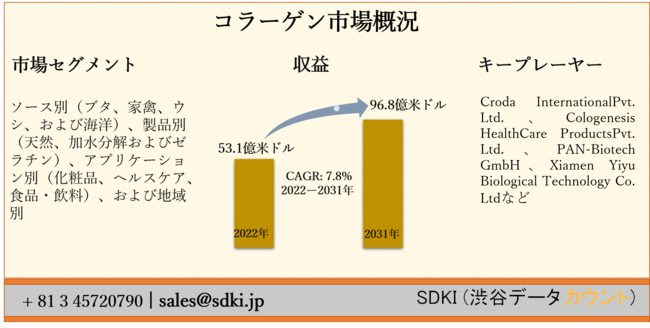
Collagen Market-By Source (Pig, Poultry, Cow, and Marine), By Product (Natural, Hydrolyzed and Gelatin), By Application (Cosmetics, Healthcare, Food and Beverage), and By Region-Forecast 2022-2031

SDKI Inc. published a new report on the collagen market on January 25, 2022.  This study includes the statistical and analytical approaches ...