Monday, 18 February 2019

Enterprise Video Content Management Market – Software Platform Emerges as Profitable Component Segment

A fresh commerce and business study by Transparency Market Research (TMR) has observed that as small and medium enterprises (SMEs) mushroom across the world, the vendors who are ahead of the curve in the global enterprise video content management market will continue to find vast new opportunities, especially when they are willing to expand into the emerging economies in Asia Pacific. For instance, about a year ago, Panopto partnered with Ramp to provide businesses and universities an optimized mode of streaming video to large and geographically distributed audiences.

Around the same time, Qumu collaborated its video content solutions with V-Cube’s conferencing system solutions to cater to targeted audiences in Japan and rest of the Asia Pacific. The report identifies IBM Corporation, Microsoft Corp., Adobe Systems, Inc., Qumu, Inc., Kaltura Inc., Panopto Inc., Brightcove, Inc., MediaPlatform Inc., Sonic Foundry, Inc., and VBrick Systems Inc. as some of the prominent companies currently operating in the global enterprise video content management market.

As per the estimations of the TMR report, the demand for enterprise video content management, across the globe, will increment at an impressive CAGR of 10.5% during the forecast period of 2017 to 2022. By the end of the forecast period, 2022, the revenue in this market is projected to be worth US$13,309.0 mn, which is substantially up from its evaluated valuation of merely US$8,070.4 mn in 2017.

In the near future, most of prominent companies are expected to adopt the latest technology pertaining to communication and lure newer customers. The report has also noted that security of confidential information is turning into a glaring issue and several market players will aim to fix this in order to consolidate their positions, primarily by focusing on hybrid and on-premises architectures to secure video data on-premises.


Based on component type, the global enterprise video content management market currently gains maximum demand for software platform, a segment that generated a revenue of US$5,811.3 mn alone in 2017, which was nearly 72% of the overall demand. This particular segment is expected to sustain its strong demand until 2022 too, when it is estimated to be worth US$9,286.6 mn, serving 69.8% of the demand as opposed to other segment of support services. Geographically, the TMR report rates North America as most lucrative region. The North America enterprise video content management market is projected to be worth US$4,293.6 mn by 2022, expanding at a CAGR of 9.6% during the forecast period of 2017 to 2022.

Rising adoption of cloud technology, growing awareness regarding the benefits of video as a tool that can enhance communication and collaboration across enterprise on the real time, growing penetration of high-speed internet, and increasing demand for video streaming are some of the key factors augmenting the demand in the global enterprise video content management market. Almost all SaaS and hybrid vendors are offering stronger security as cloud-based platforms gain adoption. These solutions aids enterprises to improve their efficiency by enabling secure information communications, capture and manage video content, and document processing. Features such as webcam, audio recordings, creation of screen, and media publication helps the corporate organizations to access their important data from remote locations on their smartphones and tablets.

Location based Services to Dominate Global Mobile Mapping Market

Leading companies to name in a largely consolidated global mobile mapping market are Google Inc., Microsoft Corporation, Mitsubishi Electric Corporation, Telefonaktiebolaget LM Ericsson, Qualcomm Inc., Apple Inc., Tomtom NV, Garmin International, OSI Geospatial Inc., and Leica Geosystems Inc.

According to a commerce and business intelligence study by Transparency Market Research (TMR), the global mobile mapping market is predicted to display a strong 13.7% CAGR over the forecast period between 2017 and 2022. At this pace, the market’s valuation of US$12.9 bn in 2017 will become US$24.4 bn by 2022 end. Based on solution, location based services segment is predicted to dominate through 2022, rising at a CAGR of 16.2% therein. In absolute value, the segment is predicted to be worth US$10.1 bn by the end of 2022.

With mobile mapping applications increasingly becoming common in smart electronics, the location based services segment is poised to remain dominant contributor to the overall market. The location based services segment held 37.2% of the global mobile mapping market in 2017. By geography, North America is predicted to continue to remain dominant region for mobile mapping. Extensive use of advanced smartphones and surge in development of mobile mapping technology based apps are key to the growth of North America mobile mapping market.


The mobile mapping market is rising at an impressive pace due to several factors, says the author of the report. Over the past twenty years, the demand for geo-spatial data has surged exponentially which is a key factor behind the growth of mobile mapping market. While geo-spatial data can be obtained via several sources, data which is more accurate, has higher density, is rapidly produced, and acquired in a less expensive manner is most sought after. Mobile mapping systems integrate various remote sensing technologies with navigation that allows mapping from moving objects (e.g., airplanes, cars, boats, etc.). This serves to obtain the 3D coordinates of the points of interest.

Equipped with GPS Capabilities, Ubiquity of Smartphones Serves to Boost Growth

Rapid advancement of satellite mapping technology and its easy integration into smartphone design is boosting the mobile mapping market. As smartphones become ubiquitous and sophisticated, mobile phone manufacturers are increasingly equipping them with global positioning system (GPS) capabilities. Today, most smartphones are considered the most widespread platform equipped with low-cost GPS receiver and motion sensors, which provides the location of the user within few meters of accuracy. This makes for one of the most important feature of smartphones. Furthermore, growing interest of large mobile application developers to develop user-friendly mobile mapping applications is likely to boost the growth of mobile mapping market over the coming years.

Solid State Drive Market – Primary Storage Provided By Solid State Drives In Handheld Portable Devices to Boost Market Growth

The increasing competition in the global solid state drive market is expected to create a consolidated market structure, as observed by Transparency Market Research. In 2014, Micron Technology, Intel Corporation, and Samsung Electronics Co., Ltd held 51% of share in the global solid state drive market. In addition, the key manufacturers are investing in research and development activities that could drive the demand in this market. To improve the geographical reach companies are investing in merger and acquisitions and targeting key segments that could help in providing strategic solution to clients and enterprises. Tapping new market to strengthen their geographical reach is also a business strategy used by these companies.

According to the statistics provided by Transparency Market Research, the global solid state drive market is projected to rise at 40.7% CAGR during the forecast period from 2015 to 2022. Rising at this rate the market is expected to touch US$29.4 bn by the end of 2022 progressing from US$ 15.4 bn as estimated in 2014.

Based on end user, in 2014, the client SSD segment led the global solid state drive market. As client SSDs are used in consumer tablets, notebooks, and desktops PC, they provide high performance, longer battery, and are light in weight their demand in increasing at a rapid pace. Based on geography, Asia Pacific is considered one of the key region due to the presence of leading players in the region. moreover, growing demand for mobile devices and laptops especially in countries like China, Japan, and South Korea has led to rise of this region.

Growing Use of Solid State Drive in Mobile Phones to Drive Market Growth 

As solid state drive are widely used in mobile phones, thus, with bolstering demand in the mobile phone industry is likely to boost the demand for solid state drive. To reduce the application launch time and enhance the performance of mobile phones solid state drives are used. Leading mobile companies such as Apple has incorporated SSDs in mobile devices, which has further augmented the demand in this market.


Moreover, hand-held devices such as ultraportable computers and notebooks where SSDs plays a crucial role in primary storage has increased large growth opportunity for the solid state drive market. High performing features such as garbage correction, error correction, and encryption and less power consumption are some of the other noticeable factors driving the solid state drive market.

High Cost to Restrain Demand for Solid State Drive  

On the other hand, few challenges are hampering the growth in the solid state drive market. High cost of solid state drive is one of the key challenge hampering the growth of this market. High cost of raw materials, expensive manufacturing process, and relatively low market is impacting negatively on the market growth. In addition to that, inconsistency in low rate latency have also added in increasing the restraints faced in this market.  However, high cost is expected only for short duration as with time solid state devices will eventually beat HDD prices in the forthcoming years. This may limit the possibility of adoption of lucrative opportunity in the low-cost mobile sector. On the other hand, technological advancements are likely to benefit the market’s growth and increase the capability of solid state drive overpowering the services offered by HDD.

Hybrid Device Market – Growing Awareness among the Companies Boosts the Market Demand

Since past few years, there has been a significant inclination towards different work habits, such as employees working out of the office premises, increased usage of mobile devices such as laptops and tabs with cloud-based data storage facilities to accomplish business tasks. This increased in the enterprise mobility is boosting the demand for hybrid device market worldwide, states Transparency Market Research (TMR) in its recent research report.

As reported by a TMR analyst the global hybrid device market is anticipated to experience a robust growth with a CAGR of 20.80% from the duration 2015 to 2022. The market was evaluated to be worth US$ 5.1 bn in 2014, which is likely to reach around US$ 31.8 bn by the end of 2022. Based on end-users, the personal use segment was anticipated to rule the demand for hybrid device with an evaluation of revenue, worth US$ 1.6 bn in year 2014.

This segment is expected to continue dominating the market demand. In telecom and IT sector, the demand is foreseen to be boosted with a whooping CAGR of 25.6% from year 2015 to 2022. As per the geographical segments, Asia Pacific is the leading segment among the rest of them. This region is anticipated to foresee the solid growth in coming years because of the economic development in countries such as India, China, Japan, South Korea, and Australia. The revenue of the region is likely to be evaluated around US$ 10.4 bn by the end of 2022.

Some of the key players in the market are ASUSTeK, Lenovo, and Hewlett-Packard. Samsung Corp., Microsoft Corp., Acer Inc., Dell Inc., Fujitsu Ltd., Toshiba Corp., and LG Corp. are some of other significant firms flourishing in hybrid devices market across the world. ASUS has recently launched its ZenBook Flip S, a hybrid device with a 360-degrees flip display, with Windows 10 operating system. Another leading company, Dell has also introduced some latest addition in its gaming system – two new members in Alienware gaming monitors, and one in Inspiron models as well that allows several storage devices to be configured. The firms are constantly revamping and innovating latest products in order to maintain their position in the market and flourish more.


With the fast-moving lifestyle, there has been a surge in demand for gadgets with increased battery life. This has been one of the major contributing factor for the growth in hybrid devices in the global market. These devices have several advantages to it such as safe and beneficial storage of information, navigation with the help of touchscreen and stylus, and many others. There has also been a rise awareness among the firms about these devices that fuels its market demand. The significant growth in hybrid devices and enterprise mobility are anticipated to stir up the demand for global hybrid devices market.

Commercial Refrigeration Equipment Market: Trade Liberalization Helps Transportation Refrigeration Equipment to Lead Market

The global commercial refrigeration equipment market has a highly competitive vendor landscape, exhibiting the presence of numerous players, states Transparency Market Research (TMR). Companies in this market are involving into mergers and acquisitions that have given them a strategic advantage to strengthen their position in the market. Some of the key players in the commercial refrigeration equipment market are Whirlpool Corporation, Ltd., Haier, Inc. (Haier Group), Beverage-Air Corporation (Ali S.p.A), United Technologies Corporation – Unit (Carrier), Ingersoll Rand Plc, Dover Corporation, Hussmann Corporation, Metalfrio Solutions SA, Daikin Industries, and Illinois Tool Works Inc. Many companies are putting efforts in expanding their product portfolio, adopting newer strategies for product differentiation, and increasing supply of equipment for the end-use industries will expand the market.

According to TMR, the global market for commercial refrigeration equipment, which was US$ 39.44 bn in 2016, is expected to reach US$ 66.88 bn by the end of 2022. The market is also estimated to rise at a CAGR of 9.1% during the forecast period starting from 2015 and ending in 2022. Based on product type, transportation refrigeration equipment segment is expected to lead the market in coming years. Globalization and liberalization of agriculture will give impetus to the segment over the coming years. Geographically, in the global commercial refrigeration equipment market Asia Pacific is holding the leading position as a reason for increasing food industry in the region. Growing disposable income is also contributing in increasing this market in Asia Pacific region.

Increasing Demand for Processed Food to Boost Commercial Refrigeration Equipment Market 

Globally, changing lifestyle has developed the need for ready to eat food products. Moreover, the need for products that have high shelf life and limited time dedicated to household chores have significantly boosted the demand for processed food. Therefore, these factors will increase the demand for commercial refrigeration equipment market. Moreover, increasing demand for eggs, meat, fish, and other animal derived food has certainly expanded the market for commercial refrigeration equipment.


Advancements taking place in refrigeration equipment that are focusing on providing high efficiency with price regulation has gained momentum to expand the commercial refrigeration equipment market. Furthermore, developing horticulture and animal husbandry practices where in a large amount animal meat and products needs to be stored that may boost the market for commercial refrigeration equipment market.

Asia Pacific to Remain Leading Consumer of Ventilation Fans Market

The long-term partnerships between manufacturers and distributors of ventilation fans is the defining characteristic of the competitive landscape of the global ventilation fans market, finds Transparency Market Research (TMR) in a new study. Only a few players, namely, Delta Ventilation Ltd., Panasonic Corp., Nortek Inc., and Airmaster Fan Co. have been able to firmly establish themselves in this highly fragmented market as of 2015.

The presence of a large pool of regional players has intensified the competition in this market. Leading participants are increasingly focusing on strengthening their presence through mergers and acquisitions while small-scale manufacturers of ventilation fans are improving their product portfolios in order to gain a strong foothold.

Going forward, manufacturers will need to focus on geographical expansion by developing their distribution channels. Product innovation will also help these players in gaining a competitive edge, TMR expects.

Infrastructural Developments Boost Demand for Ventilation Fans

The increased construction of residential and commercial spaces, thanks to the growing population as well as rapid urbanization across the world, has boosted the demand for ventilation fans remarkably, states an analyst at TMR.


The economic rise of BRICS nations and the commencement of major infrastructural development projects in the Middle East and North American countries have propelled the construction industry in these regions. Recently, economies such as the UAE, Saudi Arabia, and Qatar have undertaken huge commercial as well as residential construction projects. With the rising construction of commercial structures such as offices and hotels, the demand for ventilation fans is increasing significantly in these regions.

Apart from this, in the coming years, major sports events are scheduled to take place in Brazil (Olympic 2016), Russia (FIFA World Cup 2018), and Qatar (FIFA World Cup 2022). As such large-scale events entail first-rate infrastructure and other auxiliary amenities, these fans are likely to witness substantial demand in the next few years.

Smart Cards Market – Higher Usability of Contactless Smart Card to Enable the Market Flourish

The dominance of four companies can be seen explicitly in the global smart card market. NXP Semiconductors NV, Gemalto NV, Infineon Technologies AG, and Giesecke & Devrient (G&D) GmbH are the leading players, which hold dominant share in the global smart card market. Some of the new entrants such as Watchdata and Eastcompeace Technology Co. Ltd. are making significant efforts to give a tough competition to the existing players in the market. New players are providing solutions based on consumer preference.

The global smart card market stood at US$8.5 bn in 2016. Due to increasing technological changes, the market is expected to reach US$14.1 bn by the end of 2023. Due to consistent growth and increasing use of smart cards, this market is estimated to rise at a CAGR of 7.4% during the forecast tenure between 2016 and 2023.

The significant contribution made by contactless smart cards will help the market to grow at a healthy rate. The contactless smart cards is a segment under the types of smart cards available in the market. On geographical note, Latin America has gained its momentum in the last few years and shows more than 70% of market penetration. Asia Pacific is also considered among the prospective regional destinations for growth in coming years.

High Security Provided by New Smart Cards to Help Market Growth

The use of smart cards is considerably rising across various industries such as BFSI, telecommunication, e-commerce, healthcare, and retail. Among these, the telecommunication sector is likely to exhibit high demand for smart cards. Moreover, the exponential rise of mobile phone subscribers and increasing penetration of mobile phones in emerging economies will further benefit the global smart card market.


There are number of factors significant for the growth of smart cards. One of the major factors is high security provided by the smart cards. The current smart cards have EMV chip on chip that provides an extra level of security and protects information of the user. In addition, increasing use of near field communication (NFC), net banking, internet of things, and e-commerce that have grown the demand for smart cards at a higher rate across the globe. Thus, these factors are expected to fuel the demand for smart cards in coming years.

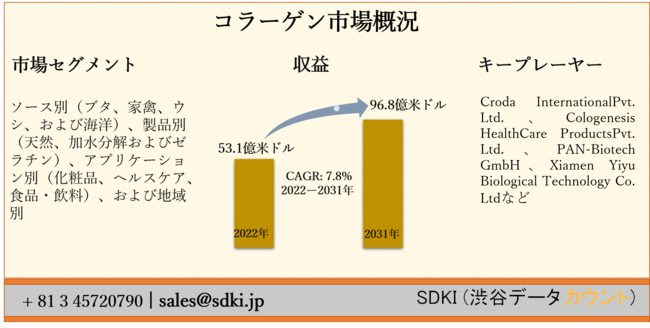
Collagen Market-By Source (Pig, Poultry, Cow, and Marine), By Product (Natural, Hydrolyzed and Gelatin), By Application (Cosmetics, Healthcare, Food and Beverage), and By Region-Forecast 2022-2031

SDKI Inc. published a new report on the collagen market on January 25, 2022.  This study includes the statistical and analytical approaches ...