Tuesday, 29 January 2019

Connected Retail Market – Transforming Retail Through IoT Innovation

A recent business and commerce publication by Transparency Market Research (TMR) has observed that the demand in the market for connected retail is expanding leaps and bounds and a number of players are connecting to the value chain. There are widespread possibilities with the growing field of the Internet of Things (IoT), paving a reliable mode of interaction between a company and its customers. The analysts of the report have evaluated that the global connected retail market was worth merely US$16.30 billion in 2016 and US$19.46 billion in 2017, but the future prospects are enormous with the valuation of the market estimated reach US$82.31 billion by the end of 2025. During the forecast period of 2017 to 2025, the demand in the global connected retail market is projected to increment at a phenomenal CAGR of 19.8%.

Product Innovation Paramount for Major Players to Maintain Leadership

“For the market leaders to stay ahead of the curve, product innovation is paramount,” suggests the lead analyst of the report. Nearly every major player of the global connected retail market are International vendors of technology and investment on the research and development of innovative products is their primary focus. However, there are strong possibilities of new entrants making a mark in this market too via niche approaches and hence, activities of mergers and acquisitions are highly anticipated in the near future.

The TMR report identifies Amazon Web Services Inc. (Seattle, U.S.), Google Inc. (U.S.), Microsoft Corporation (Washington, U.S.), Cisco Systems (San Jose, California), International Business Machines Corporation (IBM) (U.S.), Verizon (New York, United States), Belatrix Software (Redwood City, U.S), Softweb Solutions Inc. (Chicago, U.S), ARM Holdings PLC (Softbank Group) (Cambridge,U.K), SAP SE (Germany), Atmel Corporation (Microchip Technology Inc.) (California, U.S), Intel Corporation (Santa Clara, U.S), Zebra Technologies Corp. (U.S), Fujitsu Limited (Tokyo, Japan), NXP Semiconductors NV (Netherlands), and PTC Inc. (Massachusetts, U.S) as some of the key companies in the global connected retail market.


Based on connectivity, the TMR business publication segments the connected retail market into Wi-Fi, Zigbee, Bluetooth, NFC, and others. On the basis of component, the market has been bifurcated into hardware and software. The market has been further categorized on the basis of end users into electronics and appliances, beauty, home and personal care, food and beverage, apparel footwear & accessories, home goods, sporting goods and toys, and others. Region-wise, North America is highlighted as the one that will provide the maximum demand throughout the forecast period, although the demand from Asia Pacific is primed to expand at most robust growth rate among all rgions.

Rapid Growth of Online Shopping Escalating Demand

The global connected retail market is mainly driven by the increasing adoption of the IoT across retail industries. Additionally, rapid growth in online shopping is another major driver of the market. The Internet of things (IoT) are focused upon innovation and are generating new opportunities by bringing consumers and every object into the digital realm. Application of the IoT in the retail industry will provide real-time insights from connected stores, combined with cognitive computing and rich data, which will transform the in-store experience and streamline the operations. The increasing penetration of smartphones has become the hub of interaction between customers and retailers.

Monday, 28 January 2019

EMEA to Retain its Position as Leader in Ampoule & Syringes Market

The global ampoule and syringes market demonstrates a highly dynamic and competitive landscape, finds a new research report by Transparency market Research (TMR). The market has been largely dominated by Becton, Dickinson and Co., Gerresheimer AG, West Pharmaceuticals, Schott AG, and Nipro Corp., which collectively, held a share of nearly 77% in the overall market in 2015.

Hitherto, these companies have been concentrating on making heavy investments in R&D activities; however, their focus is likely to shift towards constructing manufacturing facilities in high growth regions, such as India and China in the near future. Apart from this. Strategic alliance with leading regional participants will be another key focus area for these players over the next few years, states the research report.

As per the research study, the global market for ampoules and syringes, which stood at US$5.1 bn in 2015, is likely to progress at an impressive CAGR of 10.50% during the period from 2016 to 2024, increasing the opportunity in this market to US$12.4 bn by the end of the period of the forecast. The demand for glass ampoules and glass syringes has been much higher than other products in this market and is expected to remain so over the years to come.


An exhaustive study of the geographical segmentation of the worldwide ampoule and syringes market has also been included in this research study. According to the report, the worldwide market for ampoule and syringes stretches across Europe, the Middle East, and Africa (EMEA), Asia Pacific (APAC), Countries under the North American Free Trade Agreement (NAFTA), i.e., the U.S., Canada, and Mexico, and the Rest of the World.

EMEA has been leading the global market over the last few years and is expected to retain its position throughout the forecast period. The presence of a state-of-art medical and healthcare infrastructure, increasing shift towards home healthcare, and the rising awareness among consumers regarding the benefits of ampoules and prefilled syringes in the region. Europe has emerged as the key contributor to the EMEA market for ampoule and syringes and is anticipated to remain seated in this position in the near future. The NAFTA ampoule and syringes market is also expected to witness healthy growth over the next few years, thanks to the presence of a large number of leading pharmaceutical companies in this region, notes the study.

Non-ionizing Radiation/EMF Detection, Measurement, and Safety Market – North America to Continue as Market Leader

Solid competition characterizes the global non-ionizing radiation market, which at present is led by Mirion Technologies Inc., Narda Safety Test Solutions, and Spectris plc. The competition among the three is expected to heat up in the near future: these deep-pocketed players are seen pouring large amounts in coming up with more technologically superior and effective products to detect presence radiation.

A report by Transparency Market Research predicts the global market for non-ionizing radiation (NIR) to rise at a steady 4.57% CAGR between 2016 and 2024. At this pace, the market which was worth US$49.4 bn in 2015 would likely reach a value of US$73.8 bn by 2024-end. The volume of shipment is expected to become 547.36 mn in the same period.

Depending upon the type of device, the handheld devices hold a leading share in the global market for non-ionizing radiation (NIR) market. This is mainly because of their hassle-free usage and continued technological progress leading to more evolved versions. Our in-house team of analysts predict this segment to gross US$37.9 bn revenue by 2024-end. Geographically, North America led the market with a significant 44.0% share in revenue in 2015. Presence of numerous non-ionizing radiation/EMF detector manufacturers is mainly responsible for the growth of its market. Going forward too, the region is expected to maintain its lead.


Rising Awareness about Harmful Effects of Radiation to Drive Market

At the forefront of driving demand in the global market for non-ionizing radiations (NIR) is the growing awareness among people about the harmful effects of radiation. Elaborates the lead analyst of our report, “The ever-surging usage of electrical devices such as IoT-based devices and electronic gadgets such as laptops, mobile phones, and tablets, both at home and in industries and workplaces has caused an alarming rise of electromagnetic pollution resulting from nonionizing radiation. On account of the growing knowledge about the health risks resulting from exposure to such radiation, the uptake of solutions and products that uncover and measure radiation has risen substantially among consumers, thus majorly promoting the market for non-ionizing radiation (NIR).”

Need for Heavy Investments Hampers Market Growth

One factor posing challenge, thus preventing the market for non-ionizing radiation (NIR) from reaching its full potential, is the need for continued, large investments in cutting-edge research and development of the devices so as to come up with more sophisticated products to meet the varied needs of consumers. This somewhat reduces the profit margins of manufacturers. Apart from that, need to adhere to various strict rules framed by authorities across nations is also dampening growth opportunities of players.

Caps and Closures Market – Bottled Water Industry Leads Caps and Closures’ Demand

The five leading players in the U.S. caps and closures for non-carbonated beverages  market held a share of around 55% in the market in 2016, based on value, states Transparency Market Research (TMR) in a research report. Some of the leading companies operating in the market Bericap GmbH and Co KG, AptarGroup, Inc., Closure Systems International, Inc., and Silgan Plastic Closure Solutions have gained their leads in the market through extensive development strategies and high asset use in advancement and the establishment of more noteworthy number of assembling offices the nation over.

While there is as yet a not too bad bit of the U.S. closures and caps market for non-carbonated beverages that has a place with restricted substances, bigger makers in the beverage industry are more mindful of the brand nature of the pioneers, along these lines putting more confidence in their items. The competition in this market is likely to intensify over time with market leaders expanding their reach throughout the country through long-term contracts. The small sized vendors have the benefit of adapting to novel technologies earlier while the large vendors wrestle with extensive switching costs.

According to a TMR analyst, “The U.S. market for caps and closures for non-carbonated beverages is anticipated to register a 4.3% CAGR from 2016 to 2024. In 2016, the market was valued at US$2.64 bn and is likely to touch a valuation of US$3.82 bn by the end of 2024.” Based on application, the segment of bottled water led the U.S. market for caps and closures for non-carbonated beverages in 2016 and is likely to continue leading the market over the forecast period with a 6.1% CAGR.


“One of the main variables adding to the current rise in the U.S. closures and caps market for non-carbonated beverages is the developing interest for single-serve drinks. The requirement for particular tops and terminations that supplement the much touted hot fill process that can build the timeframe of realistic usability of various refreshment sorts. Moreover, the general interest for convenience beverages and food is expanding at an over the top rate over the U.S., with an ever increasing number of shoppers inclining towards nourishments that are nutritious and additionally simple to eat. The U.S. closures and caps market for non-carbonated beverages fits consummately into this developing specialty and will keep on benefitting from this expanding request over the not so distant,” states a TMR investigator.

Different components driving the U.S. caps and closures market for non-carbonated beverages incorporate the expanding support created via regular refreshments and the occasionally expanding interest for frosty or hot refreshments, and the expanding acknowledgment of current refreshments by bigger socioeconomics and gatherings of people.

Wireless Charging ICs Market to Witness Most Prominent Growth

Transparency Market Research (TMR) recently published a market research report that elucidates the vendor landscape of the global market for wireless charging ICS. Witnessing the huge market potential, several new players have entered the global market for wireless charging ICs over the past decade. It is expected that the entry of new players into the global market will prompt a counter response from the existing players. This response could take the shape of better and more innovative strategies, introduction new product lines, or expansion of geographical reach. Although the current competitive landscape of the global wireless charging IC market is largely consolidated, it is expected to undergo progressive fragmentation over the forthcoming years.

The current market players in the global wireless charging IC market have been making coordinated efforts to strengthen their position in the market. On the other hand, the new entrants in the global market for wireless charging IC are projected to form strategic alliances in order to strengthen their position in the market.

The global market for wireless charging IC is expected to grow at a boisterous CAGR of 24.54% over the period between 2016 and 2024, according to a report by Transparency Market Research (TMR). The global market was valued at US$1.43 bn in 2015, and is expected to touch a stellar value of US$10.14 bn by 2024-end. Asia Pacific has emerged as the leading regional segment of the global wireless charging IC market while receiver ICs have outdone the transmitter ICs in terms of demand.


In the contemporary times, portable consumer electronics have become an important part of the lives of people. This is expected to propel demand within the global market for wireless charging IC in the cotemporary times. Furthermore, travel for several business-related and leisure purposes have also led to an increased demand for wireless charging ICs. It is expected that the growth of the consumer electronics segment will give a push to the growth of the global market for wireless charging IC.

Smart watches and smart phones witnessed unprecedented levels of demand in recent times. People from all classes and backgrounds are necessarily using these electronics for their daily recourse. This is expected to give a push to the demand for wireless charging ICs in the forthcoming years.

Cosmetic Ingredients Market: Moisturizing Agents to Enjoy Continued High Demand

The global cosmetic ingredients market is expected to be intensely fragmented due to the presence of various players in the global and regional market. The competition among the players seem to be extremely tough in order to sustain their position in coming yes. Some of the major players leading the market are AkzoNobel, The Dow Chemicals, Croda International, Lonza Group, Clariant AG, Solvay SA, Evonik Industries AG, Innospec Inc., and Ashland Inc. The completion between the key players is foreseen to toughen in the upcoming years as well.

According to the research report by Transparency Market Research (TMR), the global market for cosmetic ingredients is estimated to expand at a steady 4.60% CAGR during the forecast period from 2017 to 2025. The market was valued to be of worth US$22.89 bn in 2016, and is expected to reach around US$33.80 bn by the end of forecast period.

The major usage of cosmetic ingredients are as moisturizing agents, cleansing agents, and coloring agents. Out of these, the moisturizing agents segment accounts for the most important share in this market, owing to the rigorous use of moisturizing compounds in hair care, makeup, and skin care cosmetics. The analysts are expecting the scenario to be the same in future as well. Geographically, in 2016, mainly supported by India, Japan, China, and the Rest of Asia Pacific, the region dominated the global market with a collective share of 32.02%. This is attributed to the growing economy of the nations in Asia Pacific region which is shoeing in their living standard and spending capacities as well, propelling the market growth.

Rising Disposable Income to Support Market Growth

Owing to the rise in disposable income of customers, there has been an enhancement spending abilities and aesthetic cognizance. This has surged the demand for cosmetic ingredients to a large extent. Their desire to look good all the time over the years is driving the revenue of cosmetic products significantly all across the globe, which unavoidably, is intending towards a positive angle on the surging demand for cosmetic ingredients. The rise in consciousness regarding healthy skin and the surging utilization of anti-ageing cosmetics are in in a way boosting the overall cosmetic ingredients market altogether.


Cosmetic ingredients are essentially utilized as cleansing agents, moisturizing agents, and coloring compounds. Out of these, the moisturizing agent segment accounts for maximum share in this market, by virtue of the increased usage of the mentioned segment in hair care, healthy skin, and cosmetic beauty products. Researchers anticipate that the circumstance will remain same all through the accompanying couple of years.

Delayed Approval of Strict Regulations to Hamper Market Growth

Even though the market is expected to grow substantially in coming years, the delay in the approval of stringent standards, standardizing the utilization of a couple of medical compounds may hamper the improvement of this market in future. By the by, the changing tendencies of buyers, as for the shape and their physical appearance, are most likely going to make lucrative improvement scope for the makers of cosmetic ingredients in the years ahead normalizing the effect of the hindrance.

Automotive Sector to Surface as Key End User of Lubricant Packaging Market

The global market for GCC lubricant packaging is experiencing an intense competition among its well established players. Players in the market are using novel manufacturing technology to make the market more competitive. Players in the market are spending heavy amount behind research and development activities to manufacture efficient market product, thus expanding the product portfolio. Apart from these, players are focusing on product advancements and product innovation which is likely to help them to expand their customer base and product differentiation. Some of the major players in the global GCC lubricant packaging market are Saudi Can Manufacturing Company Ltd, Mold Tek Packaging Ltd, First Press Plastic Moulders Ltd., Neelkamal Plastics Factory LLC., and Duplas Al Sharq.

According to a recent study by Transparency Market Research, the global GCC lubricant packaging market is predicted to expand at a robust CAGR of 3.30% during the assessed period 2016 – 2024. The market which was worth at US$162.7 mn in 2016 is likely to be valued at US$210.4 mn by the end of the assessed period. The market on the basis of end user is classified into chemicals, machine industry, oil and gas, power generation, metal working, automotive, and other manufacturing. Of these, the automotive sector holds the majority of the share owing to significant rise in the automotive sector. Booming automotive industry sector to provide lucrative growth opportunity in the market. On the other hand, chemical industry will exhibit a decent rise in the coming years. On the basis of region, Asia Pacific is anticipated to held the majority share and is predicted to dominate in the future owing to presence of major player and increase in economic conditions of the nations in the region.

Stringent Environmental Rules and Regulation to Hamper Market Growth

One of the major reasons that is helping the market to move in the forward direction is the several initiatives undertaken by the government to promote non-oil industries. Government of several countries are spending hefty amount behind non-oil industries to help it become one of the potential source of income. This is likely to help the population rely less oil industries which experiences recurrent volatility in the crude oil prices. However, on the other hand it has been noticed that the strict environmental rules and regulation imposed by various governing bodies are predicted to deter market growth.


Booming Automotive Sector to Boosts Market Growth

Rise in disposable income and rapid urbanization have significantly change people’s lifestyle. This has made them prefer premium and luxurious product resulting in increase in demand for vehicles. Rapid advancement in technology and extensive research and development activities to meet the ongoing demand for vehicles are indirectly helping the market. Rise in demand for vehicles results in high demand for lubrications. Consumption of lubricant in semi-liquid, liquid, or solid form is linked with the automobile industry. Surge in demand for packaging products such as intermediate bulk containers which store lubricant including process oil, grease, gear oil, and engine oil which are used in daily operation of automobiles is likely to foster market growth.

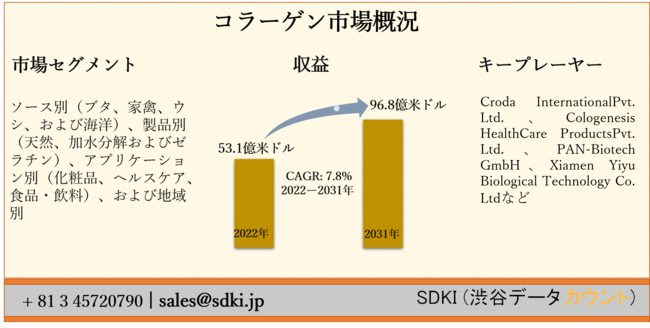
Collagen Market-By Source (Pig, Poultry, Cow, and Marine), By Product (Natural, Hydrolyzed and Gelatin), By Application (Cosmetics, Healthcare, Food and Beverage), and By Region-Forecast 2022-2031

SDKI Inc. published a new report on the collagen market on January 25, 2022.  This study includes the statistical and analytical approaches ...