Wednesday, 9 January 2019

The Rising Demand from End-use Sectors is Expected to Fuel the PET Bottles Market


Transparency Market Research delivers crucial insights on the PET bottles market in its published report, titled “PET Bottles Market: Global Industry Analysis, Size, Share, Growth, Trends and Forecast, 2018-2027”. In terms of revenue, the global PET bottles market is projected to expand at a CAGR of 4.1% during the forecast period, owing to numerous factors, about which TMR offers thorough insights and forecasts in this report.
Polyethylene terephthalate (PET) is a widely used plastic across the globe. PET bottles can be manufactured by two types of molding methods, namely - one step and two-step. PET bottles are highly consumed product in the packaging industry owing to the rising demand from food & beverages, personal care & cosmetics, pharmaceuticals, and other end-use sectors. PET bottles find useful applications in various end-use industries. PET bottles are available in various volumes from 100 ml and 200 ml to 2000 ml & above. PET bottles can be custom-made as per the requirement as well.
In the report PET bottles market, TMR suggests that the increasing consumption of beverages such as, carbonated drinks, energy drinks, packaged bottled water, and others across the globe is supposed to be the key driver for the growth of the global PET bottles market. The 500 ml to 1000 ml PET bottles segment is expected to be the most lucrative type as per capacity. PET bottles within this capacity range are easy to use and can be carried comfortably. The 500 ml to 1000 ml capacity segment is expected to account for more than 50% of the total market share in 2018. In terms of neck type, alaska/bericap/obrist account for approximately 50.4% of the total PET bottles market by market value. The TMR study analyses the PET bottles market in several regions and focuses on the key dynamics affecting the market globally. There is a consistently high demand for PET bottles in the market due to their recyclability as compared to other materials. These factors are supposed to drive the growth of the global PET bottles market during the next decade. In terms of end-use industries, the beverages end-use segment is expected to drive the demand for PET bottles. The plastic ban implemented by several governments impede the growth of PET bottles.
On the basis of consumption of PET bottles, packaged water segment is estimated to overtake the carbonated soft drinks market as the most consumed beverage type. The customers in the developing, as well as developed countries, are switching from carbonated drinks to energy drinks and juices. The volume sales of bottled water have grown at more than 10% in the past few years in the U.S., Germany, and Italy. The carbonated drinks segment has been witnessing a decline in sales for more than ten consecutive years, and beverage companies like PepsiCo, and Dr Pepper Snapple, are eyeing for the opportunities for PET bottles in water bottles segments. Apart from major beverage manufacturers, various local regional industries are engaging in bottled water segment. These factors are supposed to propel the demand for PET bottles during the next decade.
APAC is expected to dominate the global PET bottles market throughout the forecast period owing to the rising consumption of carbonated and other drinks in the region. In the APAC region, countries such as, India and China, are witnessing a rapid rise in industries such as, cosmetics & personal care, beverages, food and others. These industries are premiere consumers of PET bottles across the globe. This factor is supposed to create immense opportunities for the growth of the global PET bottles market in the region.

Recent Developments & Trends in the Plastic Drums Market


Transparency Market Research delivers key insights on the Plastic Drums Market in its published report, titled “Global Plastic Drums Market: Industry Analysis and Opportunity Assessment, 2018–2027”. In terms of revenue, the global plastic drums market is estimated to expand at a CAGR of 5.0% during the forecast period, owing to numerous factors, about which TMR offers thorough insights and forecasts in this report.
According to TMR analysis, plastic drums are used for shipping and storage of industrial products which require appropriate handling of the filling product Plastic drums can be made up of high-density polyethylene or polypropylene. However, polyethylene is majorly used for manufacturing plastic drums. Food grade and UN-certified plastic drums are used for food & beverages and hazardous chemicals industries. Plastic drums are stacked on pallets and can be efficiently handled during shipment. Plastic drums hold an appropriate share in the intermediate bulk containers market. These drums can be re-used nearly 30 times with repeated reconditioning. Plastic drums are available in different sizes and patterns of closures.
Some of the main capacities which are preferred by the manufacturers are 20-gallon, 30-gallon, and 55-gallon among others. Raw materials used for making plastic drums are easily available and cost-effective, boosting the growth of the plastic drums market growth. Earlier, larger metal drums were used to ship containers for oil, juice, and other liquid products, but now plastic drums are steadily replacing them. Plastic drums are lightweight and offer barrier as well as temperature resistance. Plastic drums are made up of low-density polyethylene, high-density polyethylene, and polypropylene among which HDPE is widely used. TMR believes that plastic drums are used more than steel and fiber drums, although eco-friendly nature of fiber drums is a threat to the plastic drums market.
Trends in the Global Plastic Drums Market
Companies are introducing new product ranges and security systems to enhance the performance of their plastic drums. Manufacturers are also looking for certifications to ensure the highest level of food safety. For instance, certification in accordance with FSSC 22000 (Food Safety System Certification), Comprehensive preventive measures according to HACCP, Halal, and Kosher certification among others. Some of the trends include automatic seal cap, load security system, and other specifically-designed plastic drums for preventing products from contamination.
Requirements for Safe and Secure Transportation with Plastic Drums
For efficient transportation, filling, handling and emptying of plastic drums, there are many specifications to be taken care of. The conductivity of plastic drums is a necessity in hazardous areas or ex-zones. Manufacturers are providing a conductive outer layer in plastic drums to prevent building an electrostatic charge. For sensitive or highly-permeable filling products, manufacturers are using fluorination processes to provide an anti-permeation layer, which is applied to interior and exterior walls of the plastic drum. Surface-active chemicals such as detergent and soda can damage the polyethylene material of the plastic drum. Thus, to provide resistance to cracks, an inner polyethylene layer is used. Leading manufacturers and reconditioning companies are providing locking systems to enhance their shipping facilities. 

Reinsurance Market is Expected to Reach US$ 364.59 Bn by 2026 | CAGR of 4.7%


According to a new market report published by Transparency Market Research titled “Reinsurance Market – Global Industry Analysis, Size, Share, Growth, Trends, and Forecast, 2018 – 2026,” the global reinsurance market was valued at US$ 241.14 Bn in 2017 and is expected to expand at a CAGR of 4.7% from 2018 to 2026, reaching a value of US$ 364.59 Bn by the end of the forecast period. According to the report, North America was a significant contributor to the reinsurance market in terms of revenue in 2017. The prominent market share of the region is due to the favorable regulatory environment and growth in property catastrophe protection in the reinsurance market across the region, especially in the U.S. and Canada.
Favorable regulatory environment and growth in property catastrophe protection driving the global reinsurance market
The global reinsurance market is currently driven by a favorable regulatory environment. Growing focus on sustainable growth has led to the relaxation in government rules globally. For instance, in September 2018, Insurance Regulatory and Development Authority (IRDA) approved revised reinsurance regulations in India. The core purpose behind revamping the regulations is that the maximum reinsurance business is held inside the nation and preference would be given to Indian domiciled entities. In 2016, the new SSN (Superintendence of Insurance) authorities removed the regulations which set minimum limits of insurers in projects involving small and medium enterprise. The new regulation now defines only maximum limits. Current regulatory variations are pushing the market to have fewer number of highly capitalized insurance companies. There are a large number of local players that need more capital to play in niche markets.
Subsequently, demand for financial reinsurance is expected to increase in the coming years. Furthermore, increasing activity of foreign reinsurers in the global reinsurance market is contributing significantly to the growth of the market. Thus, increasing regulatory oversight initiatives is expected to enhance reinsurance penetration, as they are expected to promote self-assurance in the insurance industry. Therefore, a favorable regulatory environment is expected to have a long term impact on the reinsurance market. Growing number of such favorable regulations by several government entities are expected to boost the reinsurance market in the coming years.
Demand for property catastrophe protection is expected to contribute significantly to insurance renewals, provisioning any material reinsured loss. Furthermore, industries such as aviation, marine, automotive, healthcare, and agriculture are expected to show huge growth due to the high insurance penetration combined with the need to guard high value assets. Moreover, occurrence of natural calamities is encouraging individuals to avail reinsurance. Lack of disposable income is one of the major factors limiting the market growth. However, rising economic activities across the globe is expected to enhance investment in the insurance sector in the near future. The impact of this restraint is expected to remain low in the coming years.

Stand-Up Pouches Market to Create Enormous Opportunities for Existing as well as New Entrants in Emerging Countries


In their latest report titled – “Stand-Up Pouches Market – Global Industry Analysis, Size, Share, Growth, Trends Historic (2013-2017) and Forecast (2018 – 2026)” Transparency Market Research (TMR) delivers key insights on the consumption of a variety of stand-up pouches for applications in different end-use industries. According to TMR, the global stand-up pouches market is projected to register a CAGR of 5.4% during 2018-26, which is attributed to several factors, on which, the report provides thorough insights and forecast. The MEA stand-up pouches market is expected to witness a good CAGR value of 5.9%, during 2018-2026.
The report includes a market research study on the global stand-up pouches market, which includes market assessment and trend analysis of different product types i.e. Aseptic Stand-up Pouch, Retort Stand-up Pouch, Standard Stand-up Pouch, and Hot-Filled Stand-up Pouch.
TMR suggests that the high growth in consumption of food & beverages is expected to be the major driving force behind the growth of stand-up pouches globally. Suitability of stand-up pouches for packaging liquid products will create strong demand prospects in the market. Beverage companies are shifting their product packaging from metal cans to stand-up pouches due to low weight and good barrier properties of the latter. Stand-up pouches are also significantly cheaper than other packaging alternatives which, in turn, makes them a perfect choice for the packaging of low-to-medium range products.
Owing to their multiple-layer structure, the recyclability of these pouches becomes practically infeasible. Thus, the huge amount of resin and raw materials that enter into the production process of pouches remain unrecovered. The removal of various layers of lamination from slider zipper pouches require a special process which incurs additional cost, and may add to the landfill problems. Multinational packaging manufacturers in the global stand-up pouches market are planning to expand their market presence by venturing into untapped markets of the Asia-Pacific and Latin America. However, large proportion of the demand is still fulfilled by local manufacturers.
Introduction of new design formats is expected to generate high demand for stand-up pouches in the global packaging industry. On the basis of product type, the aseptic stand-up pouches segment accounts for the largest market share due to growing brand awareness and consumer demand for hygienic products. Recycling of stand-up pouches is the key challenge in the stand-up pouches market. There are enormous growth opportunities in the global stand-up pouches market for the existing as well as new entrants. Strategic partnerships play an important role in establishing market-leading positions in any market. Private equity investors are planning to invest in the stand-up pouches market due to its extraordinary growth. Optimization of existing resources and increasing automation are the major trends observed in the market.

Inspection Drones Market - From Fighting War to Forecasting Weather, UAVs Change Everything


Inspection drone is a flying machine without any presence of human pilot onboard and also known as unmanned aerial vehicles (UAV). Drones can vary in size and shape, which are controlled remotely by a pilot or inspector. In addition, this is a flying machine that can fly independently which can function in conjunction with sensors and GPS. The inspection drone has two parts i.e. control system and the drone itself. The core elements of inspection drone are motor, microcontroller, battery, and sensors. Inspection drone are used to get a quick overview of the production sites with a high level of security and safety. Furthermore, it is also used to get data and insights of the confined area where the human access is difficult. Inspection drones are also used for commercial purposes including crop strength analysis for exactness of farming, surveillance and reconnaissance (ISR), and aerial mapping among others. Most of the inspection drones can be controlled up to 400 miles and can stay up in the air for up to 3 consecutive days. Moreover, inspection drones provide better information in a safe and less expensive manner. 
The rising adoption of inspection drone in commercial and non-commercial applications is expected to boost the demand of the inspection drones market worldwide. Additionally, it includes off-shore oil and wind energy platforms inspection, mapping and photogrammetry, detecting pipeline leakage in oil and gas industry, overviewing the production site in food industry, and homeland security. Oil and gas pipelines spans across thousands of miles, therefore, it is difficult to monitor the entire process. Inspection drone is used for detecting the hairline cracks, spillage, production outages, and unplanned shutdown. Inspection drones provide visual overview of the production site, which is also used to detect defects of the production equipment in the food industry. Higher cost of the inspection drone and lack of awareness towards the recent advanced technologies could hamper the growth of the inspection drones market.
The global inspection drones market can be segmented on the basis of types, industry vertical, range, application, and regions. Based on the types, global inspection drones market can be bifurcated into single rotor, multi rotor, and fixed wing drone. On the basis of industry vertical, global inspection drones market can be bifurcated into media & entertainment, aerospace, military and defense, oil & gas, construction, petrochemical, agriculture, food & beverages and others. Among these construction segment is expected to maintain its dominance. Over the forecast period. Growing adoption of home automation. On the basis of range, inspection drone can be segmented into three main types i.e. close range, mid-range and short range. Furthermore, on the basis of application, inspection drones market can be segmented into industrial survey & inspection, utilities survey & inspection, mapping and photogrammetry, thermography inspection, and others.
Based on the region, the global inspection drones market can be classified into North America, Europe, South America, Middle East & Africa, and Asia Pacific. The global inspection drones market in North America is expected to account the largest market due to the existing key players followed by Asia-Pacific. The growth in North America is mainly attributed to increased use of drone services in construction, aerospace, and media & entertainment industries. The Asia-Pacific market is expected to grow at the significant rate during the forecast period due to growing demand for inspection drone for security purposes.in addition, rise in construction activities in developing economies such as India, China, Japan is fueling the growth of regional inspection drones market.
The various key players operating in global inspection drones market are Airobotics Ltd., Maverick Drone Systems, DJI, Yuneec International, Freefly Systems, Wingtra, Intel Corporation, Parrot Drones SAS, Acecore Technologies, Flyability, XAIRCRAFT, Zero Tech & AeroVironment, and 3D Robotics among others.

3 Key Trends in Global Luxury Boxes Market


Luxury boxes utilized for packaging high-end products. Prominent packaging manufacturers are accessing different high quality materials and inventive shapes, as these properties improve the consumer experience. Factors such as changing buyer inclinations, growing eagerness to spend more, and rising focal point of a few brands on configuration, forms, and the overall product improvement, are boosting the luxury boxes demand. Moreover, the small scale providers are differentiating themselves by offering unique products, and customized packaging solutions for their objective clients.

With the growing partiality of individuals towards premium lifestyle, owning of luxury brands have turned into a fundamental piece of everyone's agenda. The luxury brands are gradually exploiting this changing lifestyle and are defining advancements into their products to draw more consumers and upgrade their experience to a superlative dimension.

As reported by TMR, these are 3 key trends in the global luxury boxes market:

Personalized Packaging

Makers are progressively utilizing customized packaging for making their brand among the end clients. Regularly, auxiliary packaging is adjusted for making the remarkable personality of the items or brands in the market. Aside from enhancing the stylish appearance of the product, customized packaging is utilized for defending the product amid travel by redoing the packaging as per the components of the product.


Demand for Sustainable Packaging

Plastic is a standout amongst the most broadly utilized materials for packaging over different end-use applications. The material is cost effective, and offers a solid, temperature resistant packaging solution. However, the growing demand for sustainability in packaging drives the emergence of options such as paperboard packaging. It is light weight and is picking up traction because of the surge in demand for inexhaustible and recyclable solutions for different packaging needs. This material is utilized for packaging beautifying agents, pharmaceuticals, and food and beverages. This is expected to be a prominent driving trend in the global luxury boxes market.

Advent of E-Commerce

Earlier, branded products were difficult to obtain. They were restricted to the individuals who either lived in territories sufficiently wealthy to shop, or those ready to arrange transportation. Online business has leveled the entrance barriers. Luxury packaging separates products in the libertarian commercial center. Packaging has an imperative job in keeping up a brand's picture. This is considerably increasingly imperative in the online era, as brands are discovering chances to use custom packaging to market their offering. The growing proliferation of e-commerce is thus expected to play a key role in the global luxury boxes market in coming years.

Luxury boxes constitute of a few features: the design, the materials used, and the experience. The package design is expected to reflect the vendor’s brand image. The used materials and finishing options that look and feel a little indulgent for the consumer is a key determinant of the product experience. This is expected to be key factor considered by vendors operating in the global luxury boxes market.

Prominent vendors operating in the global luxury boxes market include Smurfit Kappa Group plc, International Paper Company, DS Smith Plc, McLaren Packaging Limited, and Sunrise Packaging Incorporated.

Modular Robotics Market are Reshaping Factory Production


Modular robotics are robots that can self-reconfigure their parts to take on different forms and functions. They are also known as self-reconfiguring modular robots. Generally these robots are small in size which can connect to each other to communicate, to transfer mechanical force and electrical power. As modular robots consist of similar units they can lower module cost by mass production which has an economic advantage. Modular robots are used for various applications such as in space exploration, bucket of stuff, deep sea exploration and in search and rescue operations. For example, disaster situations like earthquake or collapsed buildings use of a self-reconfiguring modular robot could be beneficial. 
Market Dynamics: Global Modular Robotics Market
The global modular robotics market is primarily driven by wide range of applications in various industries such as aerospace and defense, healthcare industry, oil and gas, and consumer goods & services among others. Incorporation of advanced technology in aerospace and defense self-reconfiguration modular robots plays an important role, such as exploration of space or unknown environments by means of resilient and adaptive locomotion devices. These robots are capable for self-repair which is one of the most important features for space missions. Along with this, these robots are also used in oil & gas industry for deep sea exploration.
As a result of these factors, modular robotics market is expected to show significant growth in coming years. Moreover, bucket of stuff is a futuristic concept wherein the module would be able to reconfigure itself to accomplish arbitrary household task. A self-reconfiguration modular robots have some advantages such as versatility, robustness and cost-efficient as compared to conventional robots. Considering all these factors, modular robotics market is anticipated to have prominent growth in coming years. Along with that, another factor shaping the market for modular robotics is the increased complexity of the robotic system.
It is analyzed to be the major restraining factor to the modular robotics market as it is critical to recognize and choose useful configuration of modular robot and complexity in controlling. However, modular robots used in surgical operations are expected to offer significant growth opportunity to the global modular robotics market, as this system can reconfigure its own shape. Furthermore, with the help of camera mounted on it, it can capture the image of body from inside, which is very helpful to perform an operation precisely. 
Market Segmentation: Global Modular Robotics Market
The global modular robotics market has been segmented based on type, end-use industry and geography. Based on type, the global modular robotics market is classified into several architectures such as lattice architecture, chain architecture, hybrid architecture, deterministic reconfiguration and stochastic reconfiguration. Based on end-use industry, the market can be segmented into aerospace and defense, healthcare, oil & gas and consumer goods & services. Additionally, based on geography the market is further segregated into North America, Europe, Asia Pacific, Middle East & Africa, and South America.

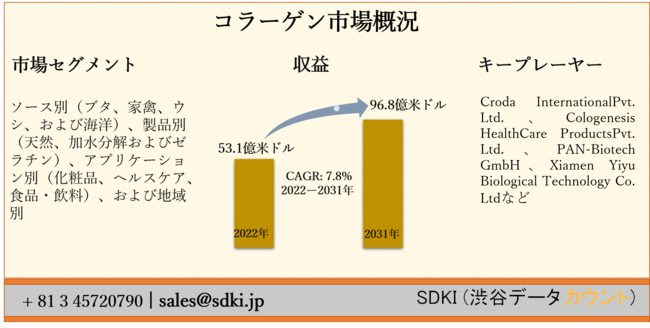
Collagen Market-By Source (Pig, Poultry, Cow, and Marine), By Product (Natural, Hydrolyzed and Gelatin), By Application (Cosmetics, Healthcare, Food and Beverage), and By Region-Forecast 2022-2031

SDKI Inc. published a new report on the collagen market on January 25, 2022.  This study includes the statistical and analytical approaches ...